
Gallery Photographers
Partner
Artists-in-Residence
If you are unable to visit our gallery and would like to purchase photographs from this preview or others in the gallery, please contact the gallery and call 585-271-2540.
Gallery Picks of the Show
Visions of Wonder
Gallery
Partners have chosen our "Picks of the Show"
by Guest
Photographers
All images copyright by the individual photographers
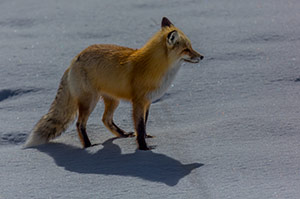
Resilient in the Snow Steve Dent, one of this year’s visiting
artists, brings both courage and artistry to the gallery, and
Resilient in
the Snow is a powerful example of his exceptional
photographic skill. His support for the gallery is deeply valued,
and his work adds a vivid, adventurous dimension to this year’s
exhibition for this year at the gallery. The
series from which this photograph is drawn was created during
Steve’s winter trip to Yellowstone—an environment most of us would
never dare to explore when temperatures plunge to minus fifteen
degrees. Yet Steve ventured out into that frigid world, seeking
moments that reveal the resilience of wildlife in conditions where
survival is a daily challenge. His photographs capture not just
animals, but the spirit of endurance itself.
Resilient in the Snow
centers on a fox standing alone in a vast snowfield. The background
offers only subtle texture, allowing the fox’s form—and its story—to
command the frame. What makes this photograph truly exceptional is
Steve’s ability to capture the fox’s shadow with precision. Shadows
in snow are notoriously difficult to compose well, yet here the
shadow becomes a vital element, grounding the animal and
strengthening the emotional impact of the image. It’s a subtle but
masterful detail that elevates the photograph. The fox’s
warm, vibrant color is the only strong hue in the composition,
creating a striking contrast against the cool, muted tones of
winter. This contrast invites viewers to appreciate the beauty of
nature in its harshest season, reminding us that even in a frozen
landscape, life persists with quiet determination.
Through this series, Steve shows us what resilience looks like—wild
creatures surviving, adapting, and thriving in conditions that would
send most of us indoors.
Resilient in
the Snow stands as a testament to his adventurous
spirit, his technical excellence, and his ability to reveal profound
beauty in the coldest corners of the world.
By Steve Levinson
Guitarist –
Jim
Dusen’s ten photographs, selected from ten years and twenty shows at
Image City, reveal a consistent interest in texture, character, and
the stories suggested by people and places. From a fossil’s
intricate spiral to layered city buildings and expressive faces, he
uses curves, repeating shapes, and carefully placed details to guide
our attention. Light highlights important features while shadow adds
depth, atmosphere, and mystery. Rich earth tones and monochromatic
treatments give much of the collection a weathered, almost painterly
quality. Together, these photographs balance drama with intimacy,
inviting us to look closely and connect with his subjects.
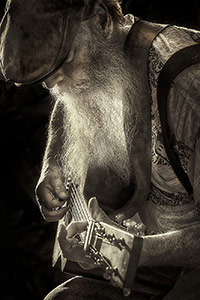
Guitarist Jim’s
photograph of a bearded guitarist draws us into a moment of deep
concentration. The bowed head and close embrace of the instrument
suggest a musician absorbed in his music, creating intimacy even
with his eyes hidden beneath his cap. The
composition leads us from the curved head through the luminous beard
toward the hands and guitar. The instrument’s neck angles into the
foreground, adding depth and emphasizing the fingers shaping the
notes. Light
catches individual beard strands and reveals the textures of skin,
fabric, and wood against a dark background. The flowing beard and
taut strings create a pleasing contrast, visually connecting
musician and instrument. Warm, restrained tones reinforce the
reflective mood, creating a portrait we can almost hear. Thank
you, Jim, for two decades of support and participation, sharing your
many thought-provoking photographs. Congratulations on your Gallery
Pick! By Dick Bennett.
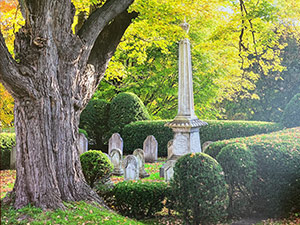
Conkling Family Plot, Jane Hopkins has spent more than fifteen
years walking among quiet stones and towering trees, developing a
body of work that treats cemeteries not as places of sorrow but as
landscapes of continuity. Her long dedication shows in
Conkling
Family Plot, a photograph that feels both intimate and
expansive, rooted in her signature exploration of the relationship
between the living and the gone. Jane’s eye is always drawn to the
dialogue between trees and monuments—the upright vitality of trunks
and branches set against the stillness of carved stone—and this
image distills that juxtaposition with remarkable clarity. The
composition is beautifully balanced. A dramatic, mature tree anchors
the foreground, its presence strong enough to counterweight the
cluster of monuments beyond it. Nothing feels accidental; the tree
and the stones seem to lean toward one another, creating a visual
conversation that guides the viewer gently through the frame.
Presented on canvas, the photograph takes on a painterly softness,
allowing light, texture, and shadow to mingle in a way that feels
almost tactile.
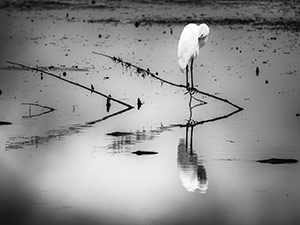
Sorrow
Julie’s recently interest in bird photography has allowed her to
create this strong, atmospheric photograph. It works particularly
well because it moves beyond a straightforward bird photograph and
becomes an image about reflection, isolation, and geometry.
The egret itself is relatively small, but its reflection extends
dramatically downward into the water. That gives the photograph a
sense of mystery and makes the viewer look twice. The branches and
their reflections create a series of triangles and diagonals across
the frame. The large triangular shape beneath the bird is
particularly effective.
The egret has its head tucked down, rather than presenting itself
proudly. That creates a feeling of solitude, contemplation, or even
melancholy. It gives the image considerably more emotional weight
than a typical wildlife photograph. The large expanse of water
surrounding the bird emphasizes its isolation. By Don Menges
by Steve Dent
by Jim Dusen
Bennington Centre Cemetery
by
Jane Hopkins
By Julie Oldfield
Image City Photography Gallery ♦ 722 University Avenue ♦ Rochester, NY 14607 ♦ 585.271.2540
In the heart of ARTWalk in the Neighborhood of the Arts